Help with flat and house hunting in Vienna — right inside the listing
A listing shows photos, size and price. What is missing often matters more — and with the extension it sits right under the address.
Add to ChromeAdd to EdgeAdd to Firefox
Free · no account · version 0.5.1 · willhaben, ImmoScout24, immodirekt, derStandard
In short: Vienna Living Map: location check for flat and house hunting in Vienna is a free browser extension for Chrome, Edge and Firefox. On Vienna listing pages it shows a card under the address: how good the area is to live in (the Living Score, 0 to 100 from six factors), the price per square metre next to the district figure (separately for flats, houses and building plots), the nearest U-Bahn in minutes on foot and the hours of direct sun at the address. It needs no account, sets no cookies and sends no visited page to Vienna Living Map.
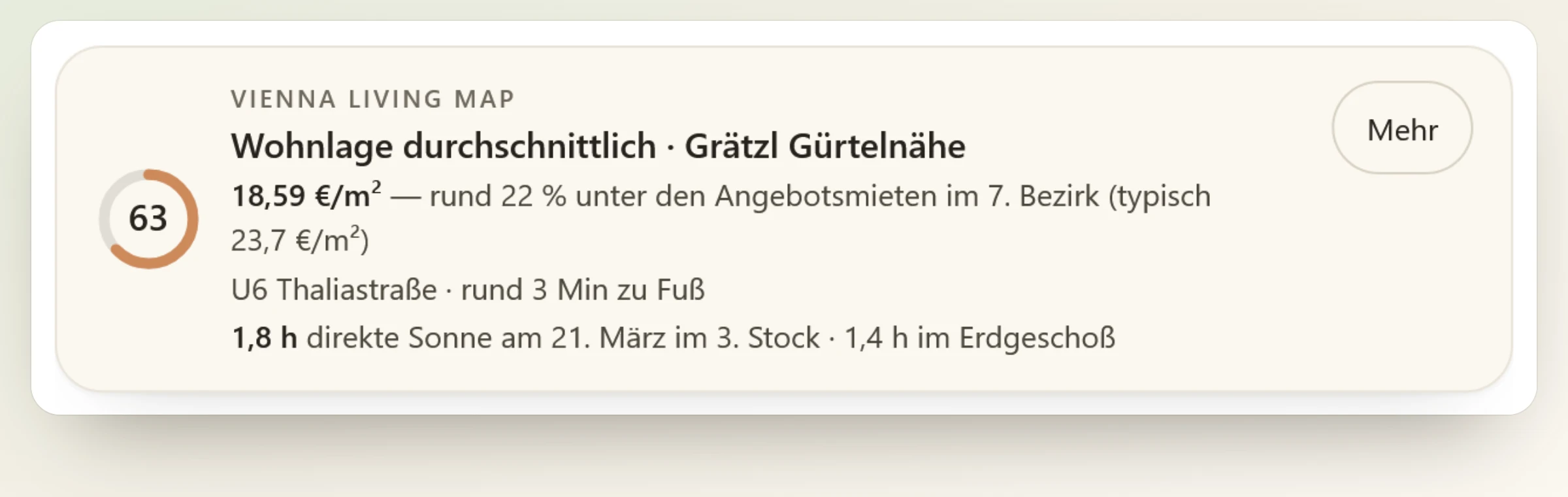
How good is the area to live in? Is the price high or low for the district? How far is the U-Bahn, and how much direct sun does the address get? The free Vienna Living Map extension puts the answers under the address line — on willhaben, ImmoScout24, immodirekt, derStandard Immobilien and other portals.
Residential location and Living Score: what the figure means
The head of the card names the residential location (“Wohnlage”) in one word: from 90 “hervorragend” (excellent), from 80 “sehr gut” (very good), from 70 “gut” (good), from 60 “durchschnittlich” (average), below that “unterdurchschnittlich” (below average). Behind it is the Living Score, a figure from 0 to 100 for how good an area is to live in — calculated from six factors that count in everyday life: safety, public transport, green space, quiet, affordability and urbanity. No district is best for everyone — if you want quiet, read the quiet; if you want short trips, the public transport. That is why the opened card shows all six values, not only the sum.
What the card answers
What the card shows on willhaben, ImmoScout24, immodirekt and derStandard
Every portal gives away something different. The card shows exactly as much as the listing itself reveals — if something is missing, the line is missing; nothing is ever guessed.
Install and start
What the extension does not do
No visited page leaves your browser towards Vienna Living Map. The extension reads the location the listing itself shows and calculates in the browser. From viennalivingmap.com it loads three public files once a day — the Grätzl, the districts and the U-Bahn stations — with no address in the request. Only if a listing carries no coordinate and the address has a house number does the address go to the City of Vienna’s address service. No account, no cookies, no counter, no selling of data. Verifiable in the manifest: one permission (its own storage for the three files, about 42 kilobytes together) and two hosts, viennalivingmap.com and data.wien.gv.at; the script runs only on the listing pages of the named portals and places a single element under the address line there (in willhaben’s results list, one ring per Vienna result) — it changes nothing in the listing itself. Privacy →
Honest about the figure
The Living Score belongs to the area, not to the single property — the card says how far away the centre of the Grätzl lies. What is calculated is direct sun at the address at the height of the floor, not how bright a room is; balconies, trees and curtains are not part of the calculation. A district price is an average across old and new, small and large properties — a flat or a house is a single case. Not an expert report — and Vienna only. Methodology →
Frequently asked
What is the Living Score?
A figure from 0 to 100 that says how good an area is to live in — calculated from six factors: safety, public transport, green space, quiet, affordability and urbanity, from open data of the City of Vienna, Statistics Austria, OpenStreetMap and Wiener Linien. Vienna Living Map calculates it for all 23 districts and around 100 Grätzl; how exactly is explained in the methodology.
Does the extension help with house hunting too?
Yes. For a house, the price per square metre sits next to the median paid for houses in the district (€ per m² of living space, purchase contracts in the land register, Statistics Austria): Döbling €10,000, Hietzing €7,069, Penzing €5,686, Favoriten €5,355, Floridsdorf €5,135, Liesing €5,000, Donaustadt €4,929, Meidling €4,575 (2024), Simmering €4,556 (2024). For the other 14 districts Statistics Austria publishes no current figure because there were too few sales — the card then gives that reason instead of a number. A building plot sits next to the land price (€ per m² of plot area: Währing €2,194, Hietzing €827, Favoriten €731). For houses the card calculates the sun on the ground floor. All districts with a figure, and what 140 m² cost there: viennalivingmap.com/en/living/buy-a-house/.
How do I find a flat or apartment in a good area of Vienna?
First decide what counts in everyday life — short trips by public transport, green space outside the door, quiet at night, a price that fits. On viennalivingmap.com, type that wish into the search (“quiet, green, with a dog”), and it shows the Grätzl that match. Then read every listing with the extension: the area, the price against the district, the walk to the U-Bahn, the sun at the address. For the one flat that is left, Azima calculates the sun in each room, noise and summer heat.
What does the extension cost?
Nothing. No account, no sign-in, no ads. Vienna Living Map earns its money with the reports in Azima: €9.50 per report, €39 a month for Premium.
Which browsers?
Chrome, Microsoft Edge and Firefox from version 140, on the computer — Chrome through the Chrome Web Store, Edge through Microsoft’s Edge Add-ons (or the Chrome Web Store as well), Firefox through Firefox Add-ons. There is no version for the phone; there the address goes straight into Azima.
Does Vienna Living Map see which listings I look at?
No. The extension sends neither the address nor the page nor an identifier to Vienna Living Map. Once a day it loads three public files that every visitor of the site loads too. For the hours of sun a small frame loads the building heights of the surroundings, like any map view; the address only sits in the part of the link the browser never sends. As with every request, the server sees an IP address.
Why do some listings only show the district?
Because the listing only names the postcode (derStandard, for example) or no house number. Then the card shows the figure for the whole district and says so — nothing is guessed.
Why are the hours of sun sometimes missing?
Hours of sun belong to a house. Without a house number in the listing there are none; if the measured heights of the neighbouring buildings are missing for a house, the card names the reason instead of a figure. With the address from the provider, Azima calculates them in a minute.
Is the extension affiliated with willhaben or ImmoScout24?
No. It is a separate tool by Vienna Living Map and is not connected to any portal. It changes nothing in the listing; it puts a card underneath. If a portal rebuilds its pages, the card does not appear — never a wrong one.
Where do the figures come from?
From open data: City of Vienna (data.wien.gv.at), Statistics Austria, OpenStreetMap, Wiener Linien. The Living Score combines six factors; how is explained in the methodology. Purchase prices for flats, houses and plots are medians of the prices actually paid, from the land register (Statistics Austria, as of 2025); rents are district asking rents, carried forward. The sun comes from the City of Vienna roof model (measured building heights) and the astronomical path of the sun.
Does it work outside Vienna?
No. Outside the postcodes 1010 to 1230 nothing appears.
For portals and agency software
The same figures — residential location, price in the district, U-Bahn, sun per floor — can go straight into a portal’s own pages without an extension: as a light widget with one line of code, as a partner link per property or as OpenImmo enrichment, today without a contract; licensing and acquisition of the technology on request. For companies →
Azima · light check · Buying? Light, heat and noise before you sign · Buying a house: house prices by district · The light tile for your own listing · The light widget for agents · Contact
Version 0.5.1. Sources: City of Vienna – data.wien.gv.at (roof model LOD2.1, address service, CC BY 4.0) · Statistics Austria (prices paid 2025: flats, houses, building plots) · OpenStreetMap contributors (ODbL) · Wiener Linien (stops). Not an expert report.