Is the flat dark? What really reaches your window in December
Whether a flat in Vienna is dark is decided by the building opposite and the floor, not by the compass direction alone. On 21 December the sun stands only about 18° high at noon: in a 15 m wide lane with 20 m buildings opposite, no direct sun reaches any floor from the ground floor to the 4th, while the 5th floor gets 6.0 hours.
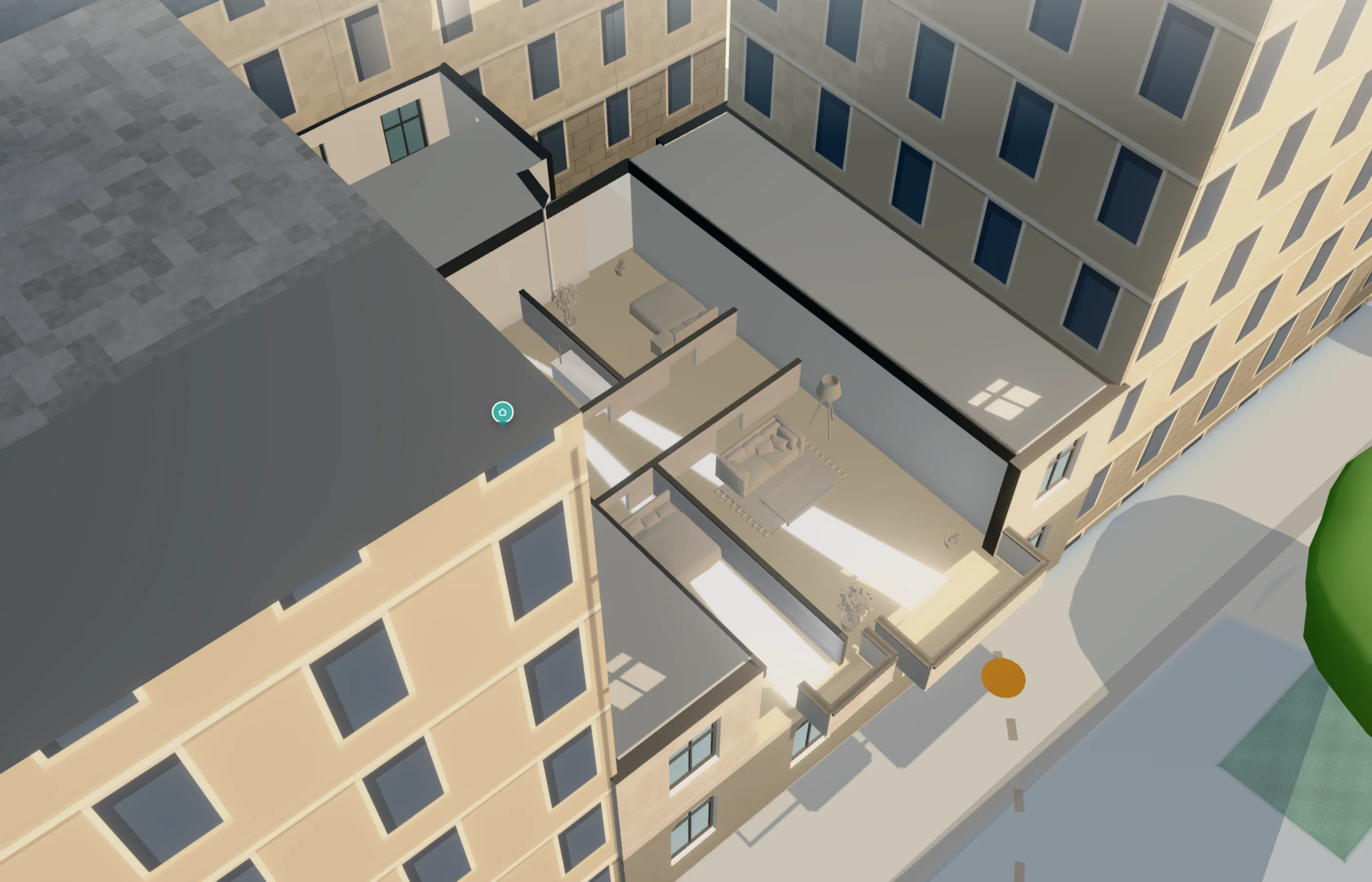
Worked exampleAt Schrankgasse 10, 2nd floor, the west windows get 6.5 hours of direct sun on 21 June, 3.3 on 21 March and none on 21 December; the bedroom facing east onto the courtyard 6.0 in June. Calculated with Azima from the City of Vienna LoD2 roof model, 2026-10-11.
How bright is your flat in winter? Type the address — Azima calculates the sun for your floor and every room.
The address goes to the City of Vienna address service for the search, never to Vienna Living Map. The result stays on this device. No account.
Why the viewing deceives
Viewings often happen in spring or summer. On 21 June the sun in Vienna stands about 65° high at noon and looks over almost every roof; on 21 December about 18° — then a building opposite that is taller than the lane is wide is enough, and the window gets no direct sun. The same flat can be bright in June and dark in December, and both are true.
The floor decides
A worked example: a 15 m wide lane, opposite a straight row of houses with 20 m eaves, the window faces it. Direct sun on 21 December, calculated at window height for each floor:
With 20 m instead of 15 m of distance, the winter sun already starts on the 4th floor. A real lane has gateways, courtyards and crossings that let light through — which is why Azima calculates with the measured buildings around the address instead of a wall.
What else makes a flat bright or dark
- The direction. In winter the low sun stands only in the south-east to south-west; a window facing north gets no direct sun from the start of autumn to the start of spring. East and west get long morning or evening sun in summer.
- Street or courtyard. A courtyard is often narrower than the street — and sometimes wider. It is not the side of the house that decides but the distance to the next wall.
- Trees. A plane tree in front of the window shades in summer and lets light through in winter. Azima shows trees in the view but does not count them as shade.
- Daylight without sun. Even without direct sun, a large patch of open sky brings light into a room. Azima calculates direct sun; it does not compute a daylight factor.
Frequently asked
Is a ground-floor flat always dark?
Not always, but often in winter: in the example above (15 m lane, 20 m opposite) the ground floor gets no direct sun on 21 December. On a square, by a park or on a wide street it looks different — only the calculation for the address shows it.
Which direction is brightest?
In winter, south gets the most direct sun, because that is the only place the low winter sun stands; east and west get long morning or evening sun in summer. A window facing north sees no direct sun from the start of autumn to the start of spring. How much of it arrives is decided by the building opposite.
How many hours of sun are enough?
There is no number that is right for everyone — someone who is out all day barely notices the winter sun, someone working from home notices every hour. That is why Azima states the hours per room on three reference days instead of a grade.
Do trees count?
No. Trees are shown in the view but do not cast shade in the calculation: a deciduous tree lets light through in winter, and trees grow and are cut back.
Where do the figures come from?
From the City of Vienna’s LoD2 roof model (the measured eaves height of every building), the terrain and the position of the sun, calculated at the window height of each floor. The calculation runs in your browser; the address does not go to Vienna Living Map.
Worked example: a straight row of houses and nothing else, calculated with the same calculation as Azima (src/lib/shadowEngine.ts, window height = floor × 3.2 m + 1.5 m), 21 December 2026. Schrankgasse 10 example: Azima’s sample exposé, City of Vienna — generalised roof model LOD2.1, data.wien.gv.at, CC BY 4.0. Not an expert opinion.
The shortest day · Will my sun be built over? · Light & sun by Grätzl · Sunlight per room · Houseplants & light