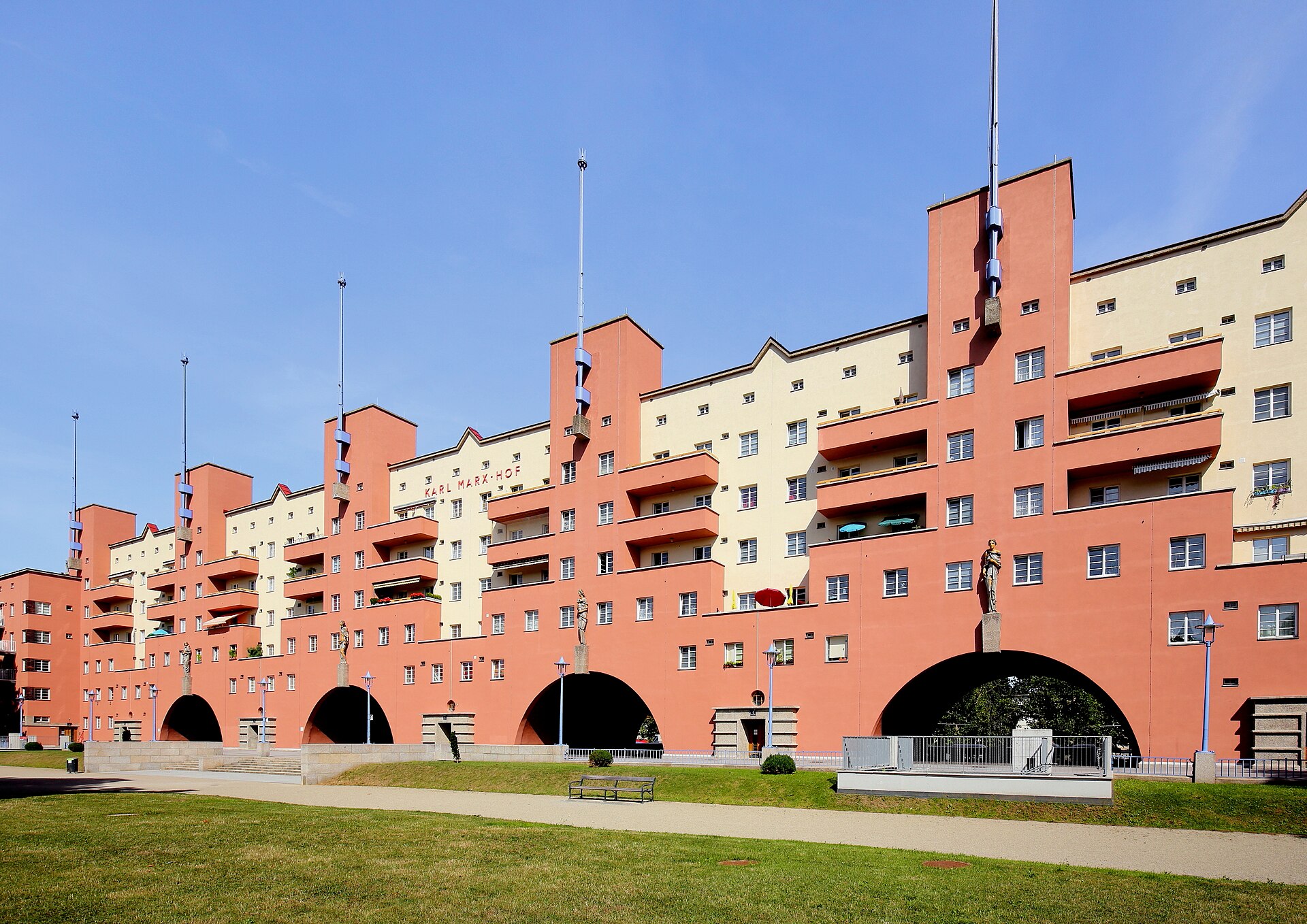
%20-%20Karl-Marx-Hof.JPG)
Where does municipal housing shape living in Vienna?
Around a quarter of all Vienna apartments belong to the city. The Gemeindebau is not a last resort but a hundred-year-old idea of affordable living — and it shapes whole neighbourhoods. We show where.
Favoriten
68,873 municipal apartments · Vienna’s biggest municipal-housing district
Ranked from open data (City of Vienna OGD, OpenStreetMap, Wiener Linien, Statistics Austria) — not a tourist tip list.
Little shapes living in Vienna as much as the Gemeindebau, the city-owned housing estate. From the monumental Karl-Marx-Hof in Döbling to the wide estates in Favoriten and Simmering, a red thread runs through the city — courtyards with trees, benches and washing lines where generations have grown up.
We count the housing estates from the City of Vienna’s open location data (1,772 estates) and their apartments around each Grätzl. The Gemeindebau stands densest in the southern working-class districts and across the Danube — where Red Vienna had the most room to build. It is a way of living with its own history and its own rules — so a culture signal, not a point in the Living Score.
The Gemeindebau districts
A whole district is too coarse — the Gemeindebau is highly concentrated. These Grätzl are shaped by it the most:
The Grätzl with the most municipal housing
The honest point: you don’t rent a municipal flat on a whim — it takes the Wohn-Ticket, an income below the ceiling and some waiting, and you cannot buy one. In return you get a regulated rent, an open-ended contract and usually green, well-connected estates. For many it is the most stable route to living in Vienna.
Famous Gemeindebauten
Over a kilometre long, opened in 1930 — the most famous municipal housing block in the world.
The largest estate of Red Vienna, a whole Grätzl in itself.
A garden-city idea of the interwar years: courtyards, trees, wide lawns.
Winding courtyards and archways — today with its own theatre inside.
Modelled on a grand Ringstraße palace, with a wide courtyard of honour on the Gürtel.
The first municipal building of Red Vienna, early 1920s — where it all began.
A 1970s mega-estate — a city within the city, with its own metro stop.
A wide estate near the Alte Donau, fought over in February 1934.
What makes the Gemeindebau
The Gemeindebau is not a housing project on the edge but an idea in the middle of the city. In the “Red Vienna” of the 1920s the city built whole courtyards with laundries, kindergartens and libraries — financed by a dedicated housing tax. To this day around a quarter of all Vienna apartments belong to the city, and about half a million people live in them. It is one of the reasons living in Vienna stays comparatively affordable.
You don’t get a municipal flat on the open market. You need the Wiener Wohn-Ticket: a main residence in Vienna, an income below the ceiling and a little patience. In return the rent is regulated, the contract open-ended, and you often live in generous, green estates with good transit. The building stock ranges from listed interwar courtyards to renovated post-war blocks — best seen in person.
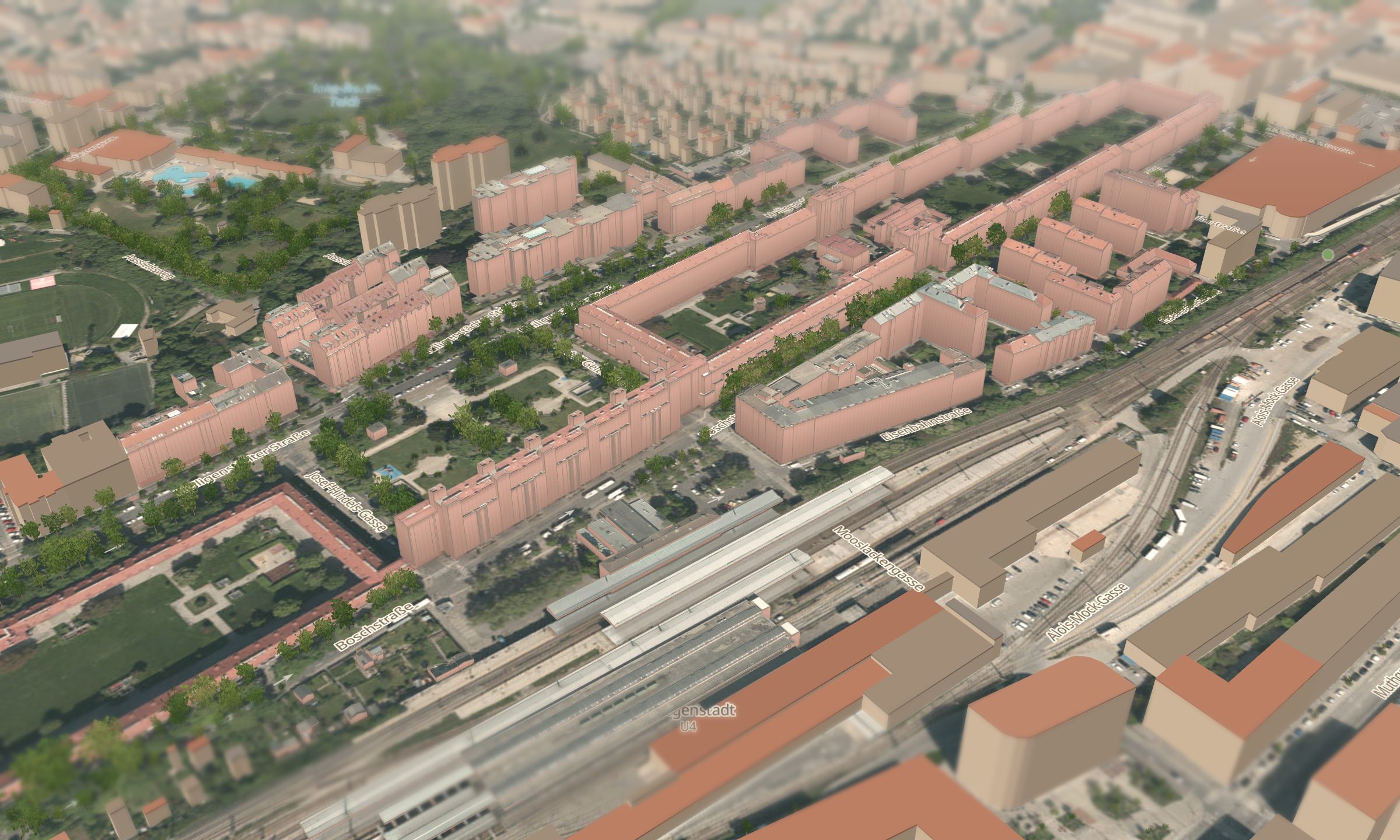 How the cityscape is built. Rendered from our own 3D map — buildings, trees and water from open data. Map data: City of Vienna (CC BY 4.0), © OpenStreetMap contributors.
On the map
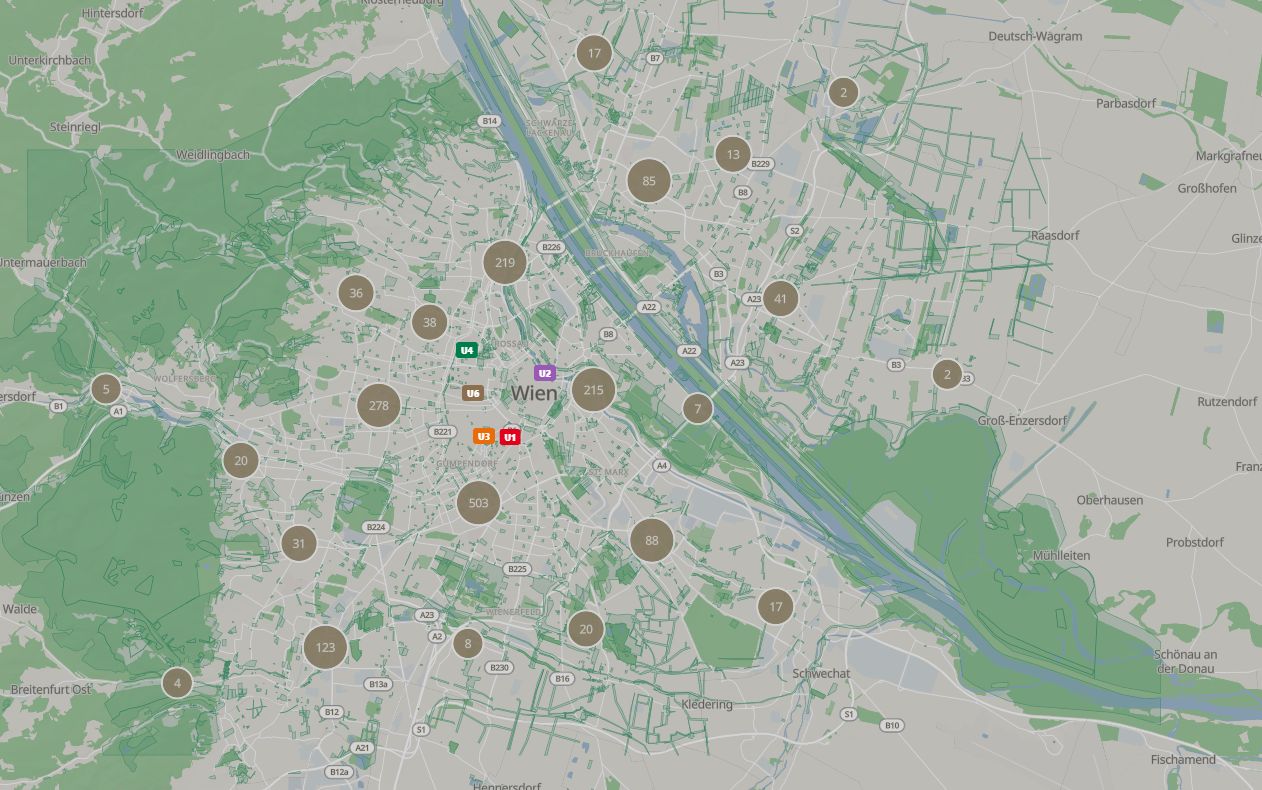 Where the theme spreads across Vienna. All 1772 on our own map with the layer on. Tap to explore live. Map data: City of Vienna (CC BY 4.0), © OpenStreetMap contributors.
Explore Gemeindebau areas
The Grätzl page shows how green, quiet and well-connected a location is — for Gemeindebau areas the transit links and the green of the courtyards matter most. A good start to get to know a neighbourhood before applying for a flat.
Explore the Gemeindebauten in Vienna Living Map →Frequently asked
What is a Gemeindebau?
A Gemeindebau is a housing estate owned by the City of Vienna and managed by Wiener Wohnen. Born from the “Red Vienna” of the 1920s, there are today around 1,800 such estates with about 220,000 apartments — roughly a quarter of Vienna’s housing stock. About half a million people live in them.
How do you get a municipal flat in Vienna?
Through the Wiener Wohn-Ticket: you must be of age, registered at the same Vienna address as your main residence for at least two years, and below an income limit. With the Wohn-Ticket you can then apply for specific flats. You cannot buy a municipal flat.
Which districts have the most Gemeindebau?
The most municipal housing stands in the working-class districts and the wide areas across the Danube: Favoriten, Simmering, Floridsdorf, Donaustadt and Meidling lead. In the Inner City and the bourgeois inner districts there is barely any.
What is the largest Gemeindebau in Vienna?
The most famous and most striking is the Karl-Marx-Hof in Döbling (19th) — over a kilometre long, one of the longest single residential buildings in the world, opened in 1930, with around 1,400 flats. By sheer number of flats the Sandleitenhof in Ottakring (16th), the biggest estate of Red Vienna, is larger.
Which Grätzl fits you? → · All 23 districts · All Grätzl · Live by lifestyle
More guides
☀️ Where should you live in Vienna to stay cool?🌳 Where do the most trees line the streets?🍷 Where do you live among Heurigen and vineyards?🌭 Where do you live with a Würstelstand round the corner?🍺 Where do you live with a Beisl round the corner?🌱 Where do you live in the green — in a Kleingarten?🐶 Where do you live well with a dog in Vienna?🚲 Where is Vienna most bike-friendly to live?☕ Where do you live in the middle of Vienna’s café culture?🛍 Where do you live with a market on your doorstep?🏡 Where do the Viennese live, not the tourists?🌲 Where do you live by the Vienna Woods — green and hilly?