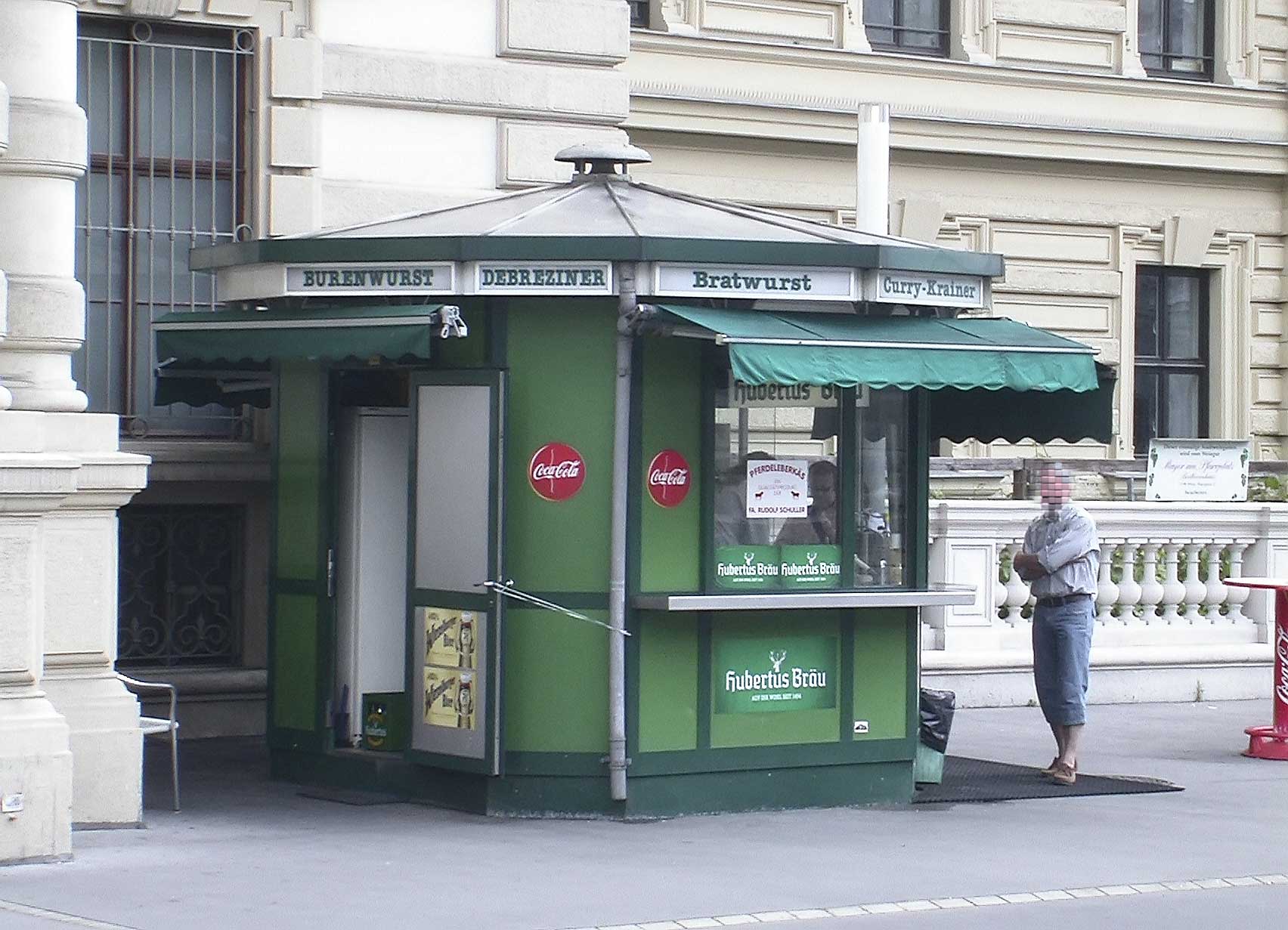

Where do you live with a Würstelstand round the corner?
The Würstelstand has been UNESCO cultural heritage since 2024 — and for many it’s the most honest piece of Vienna. Not a restaurant, not a trend: a place where, at midnight, everyone is equal. We show which Grätzl really have the stand as part of daily life.
Innere Stadt
17 sausage stands · Käsekrainer until 4am
Ranked from open data (City of Vienna OGD, OpenStreetMap, Wiener Linien, Statistics Austria) — not a tourist tip list.
A Würstelstand is more than a Käsekrainer. You stand five deep at a narrow counter, the Standler knows the regulars, and after the opera the man in tails meets the taxi driver. Some stay open until four in the morning — exactly when nothing else is. It’s not a sight, it’s infrastructure for real life.
We count the stands mapped on OpenStreetMap around each Grätzl — real locations, but not a complete registry. Famous names abound: the Bitzinger by the Albertina, where opera-goers and celebrities queue, the Leo in Döbling, open since 1928, or “Zum scharfen René”. But for living it isn’t the most famous stand that counts, it’s the one round the corner. A Würstelstand is like a café: lovely to visit — what matters is whether it belongs to your everyday. So it’s a culture signal, not a factor in the Living Score.
The Würstel districts
The stands cluster where something is going on in the evening and at night — in the centre and along the busy shopping streets. This is where they stand thickest:
The Grätzl with the most Würstelstände
The trade-off is the inner city’s: where the stand is round the corner at night, it’s also louder, denser and pricier. If you want quiet, you live quieter — and the nearest stand is a few minutes further. A Würstelstand doesn’t make an area good or bad; it only tells you how much life is outside your door.
The best-known stands
The most famous stand — opera-goers, celebrities, even Mick Jagger. Elegant, the classic for a Würstel after the opera.
Open since 1928 — the city’s oldest stand, 60-plus varieties.
Regional producers, a legendary hot Currywurst.
Since 2022, young-run, organic and regional.
The upscale take — even calamari fritti and beef tartare.
By the Bermuda Triangle, open into the early hours.
Since 1910: “Hand in Hand zum Würstelstand”.
A cult stand since the 1980s — with its own song and the “World Floridsdorf Day”. For many locals more institution than sausage stand.
How to order like a Viennese
To order like a local you don’t ask for “a cheese sausage with bread” but for “a Eitrige mit an Bugl und an 16er” — a Käsekrainer with the bread heel and a can of Ottakringer. You eat standing up and with your fingers (or the little fork); knife and fork are a faux pas. Add sweet or hot mustard, a Krokodü (gherkin) and, if you dare, an Oaschpfeiferl (hot chilli). It gets best after midnight, when tailcoats, taxi drivers and night owls share the same counter.
 How the cityscape is built. Rendered from our own 3D map — buildings, trees and water from open data. Map data: City of Vienna (CC BY 4.0), © OpenStreetMap contributors.
On the map
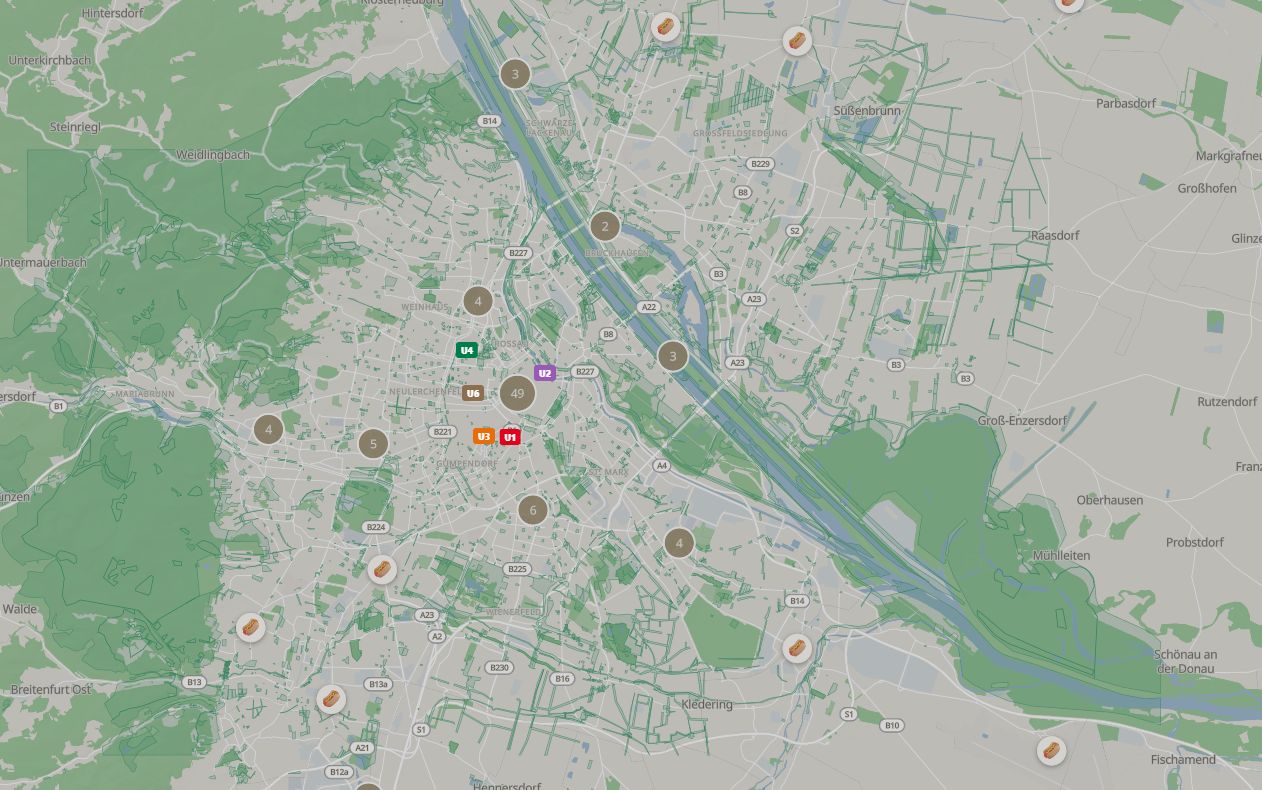 Where the theme spreads across Vienna. All 92 on our own map with the layer on. Tap to explore live. Map data: City of Vienna (CC BY 4.0), © OpenStreetMap contributors.
Würstelstände on the map
The “Würstelstand” search or the 🌭 button on the map lays the real stands over the city — as points, not a heatmap. So you can see at a glance where the nearest stand belongs to the Grätzl.
Discover Würstelstände in Vienna Living Map →Frequently asked
Why is the Würstelstand UNESCO heritage?
In 2024 UNESCO added “Viennese sausage-stand culture” to the national inventory of intangible cultural heritage. Not for the sausage, but for the place: a low-threshold meeting point where people from every walk of life come together — with its own language, its own rules and a history over 300 years old.
What do you order at a Würstelstand?
Classically the Käsekrainer (in dialect “a Eitrige”), with a piece of bread or the “Bugl” (the bread heel), sweet or hot mustard and a “16er-Blech” — a can of Ottakringer beer. You eat with your fingers or the little fork; knife and fork count as a faux pas.
Which districts have the most Würstelstände?
They stand thickest in the centre and the lively districts — around the Innere Stadt, in Neubau and along the big streets in Rudolfsheim-Fünfhaus and Ottakring. In quiet residential areas on the city’s edge the nearest stand is a bit further.
Which Grätzl fits you? → · All 23 districts · All Grätzl · Live by lifestyle
More guides
☀️ Where should you live in Vienna to stay cool?🌳 Where do the most trees line the streets?🍷 Where do you live among Heurigen and vineyards?🍺 Where do you live with a Beisl round the corner?🌱 Where do you live in the green — in a Kleingarten?🏢 Where does municipal housing shape living in Vienna?🐶 Where do you live well with a dog in Vienna?🚲 Where is Vienna most bike-friendly to live?☕ Where do you live in the middle of Vienna’s café culture?🛍 Where do you live with a market on your doorstep?🏡 Where do the Viennese live, not the tourists?🌲 Where do you live by the Vienna Woods — green and hilly?